APIs and excipients are both essential to every tablet, capsule, or liquid formulation — but they play fundamentally different roles, and pharma companies that blur the distinction in their sourcing strategy end up qualifying the wrong things.
What an API Intermediates does
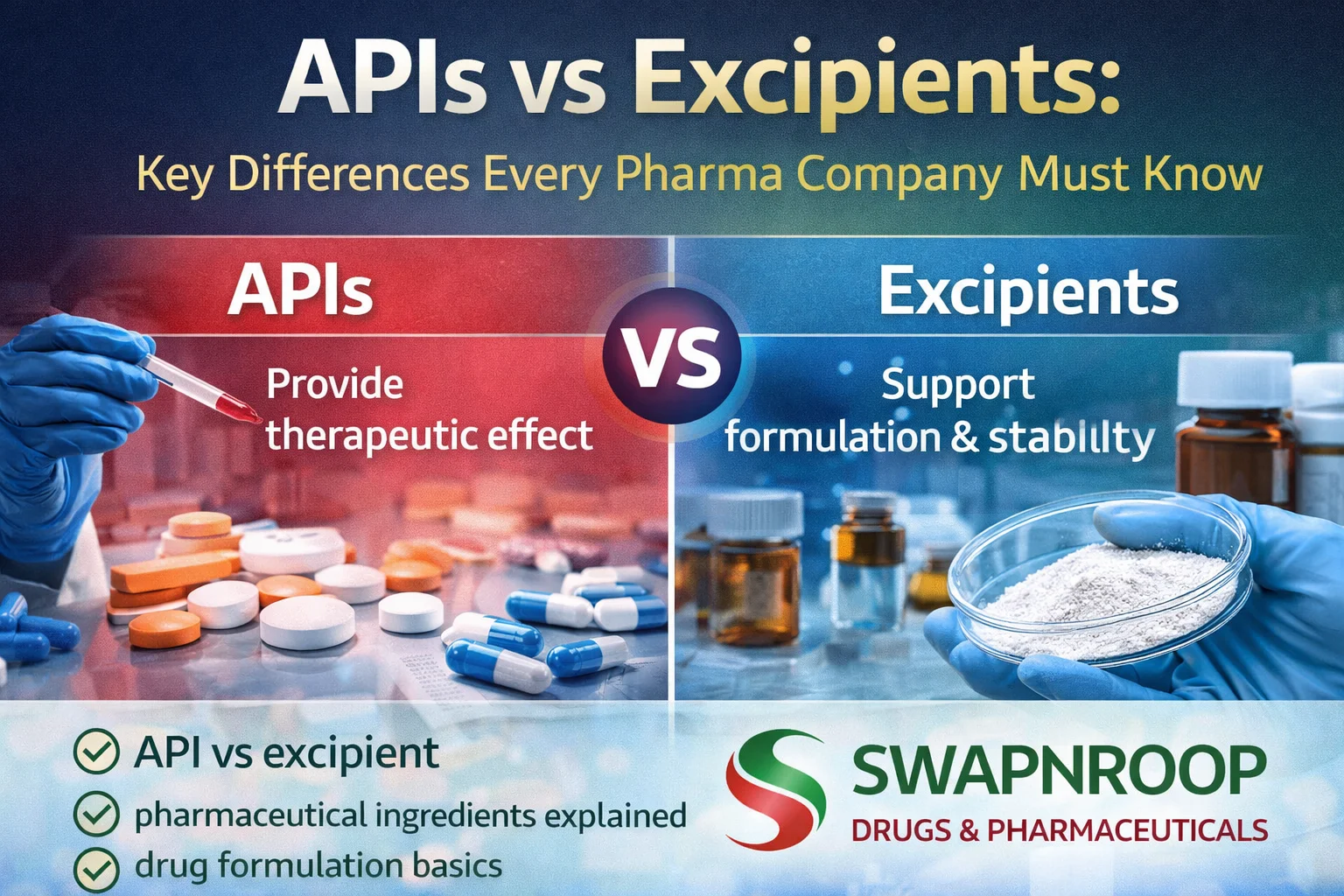
The Active Pharmaceutical Ingredient is the molecule that produces the intended therapeutic effect. Its purity, impurity profile, and particle characteristics directly affect efficacy and safety.
What an excipient does
Excipients are the inactive components — binders, fillers, disintegrants, coating agents — that give a formulation its physical form, stability, and release characteristics. An excipient shouldn't have a pharmacological effect of its own, but its quality still affects how the API intermediates performs.
Key differences that matter for sourcing
- Regulatory scrutiny: APIs typically require DMF filings; excipients are governed by pharmacopeial monographs and functionality testing.
- Quality focus: APIs are assessed primarily on assay and impurity profile; excipients are assessed on functional performance (flow, compressibility, disintegration time).
- Documentation: Both require a Certificate of Analysis, but DMF-level documentation is generally API intermediates-specific.
Why both deserve the same rigor
A poor-quality excipient can undermine an otherwise perfect API intermediates — inconsistent binder performance can affect tablet hardness and dissolution just as much as an impure active ingredient. Sourcing both from a single WHO-GMP certified manufacturer with consistent documentation standards, like Swapnroop Drugs and Pharmaceuticals, reduces variability across your entire formulation.